Contextual Leadership Portfolio
A digital portfolio by Asheley Griffin exploring calling, leadership identity, congregational care, and a practical intervention for One City Church.
Long-term reflection, not just assignment submission.
This page presents the five major course assignments as a clean digital portfolio. Instead of placing full papers on the page, each paper is summarized with three focused highlights and a link to the full document.
Care as Calling
The portfolio moves from personal formation to public leadership practice: God shapes the leader, the leader discerns the context, and the church builds structures that make love visible.
Portfolio Map
Becoming the Church
A spiritual autobiography tracing prayer, Apostolic formation, suffering, motherhood, surrender, and the recognition that God had been forming Asheley for ministry long before she could fully name it.
- Five generations of church life and prayer form the foundation.
- Isaiah 6 becomes a central image for holiness, worship, and calling.
- The story connects endurance, observation, and care as part of God’s long formation process.
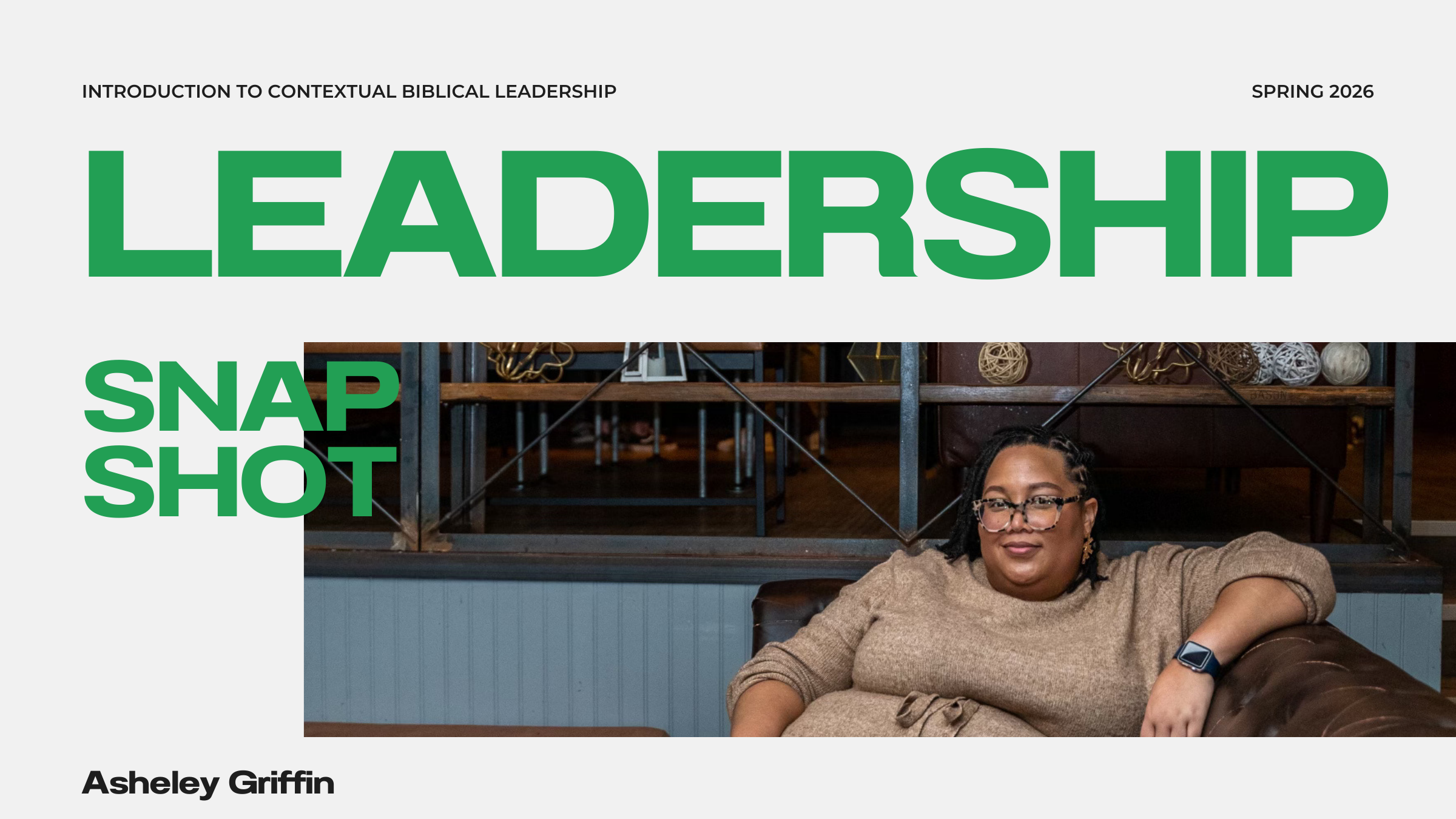
Leadership Snapshot
A visual profile of Asheley’s leadership wiring: analytical, values-anchored, systems-minded, restorative, precise, and shaped by calling.
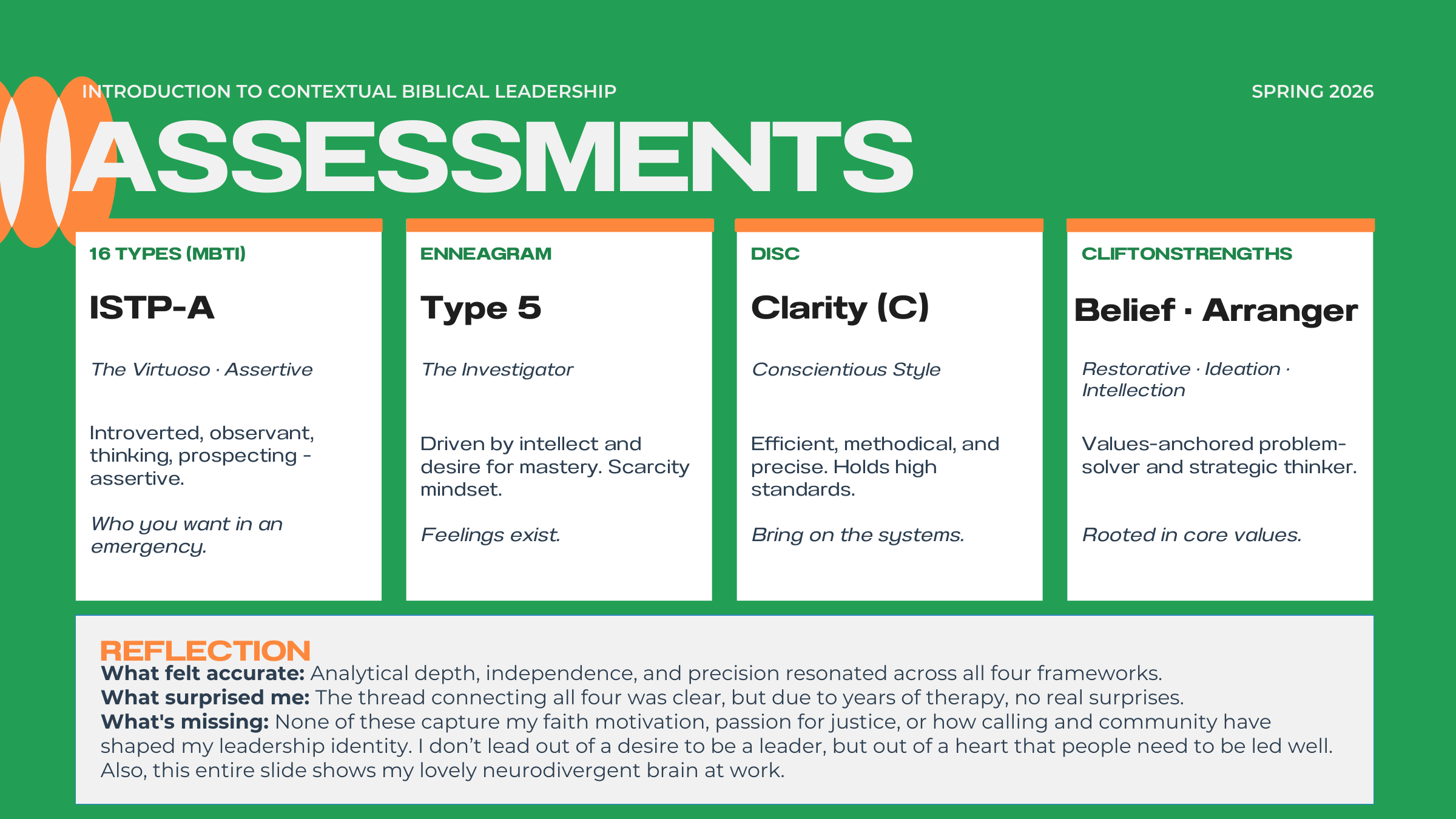
- Assessment themes include ISTP-A, Enneagram Type 5, DISC C/Clarity, and CliftonStrengths.
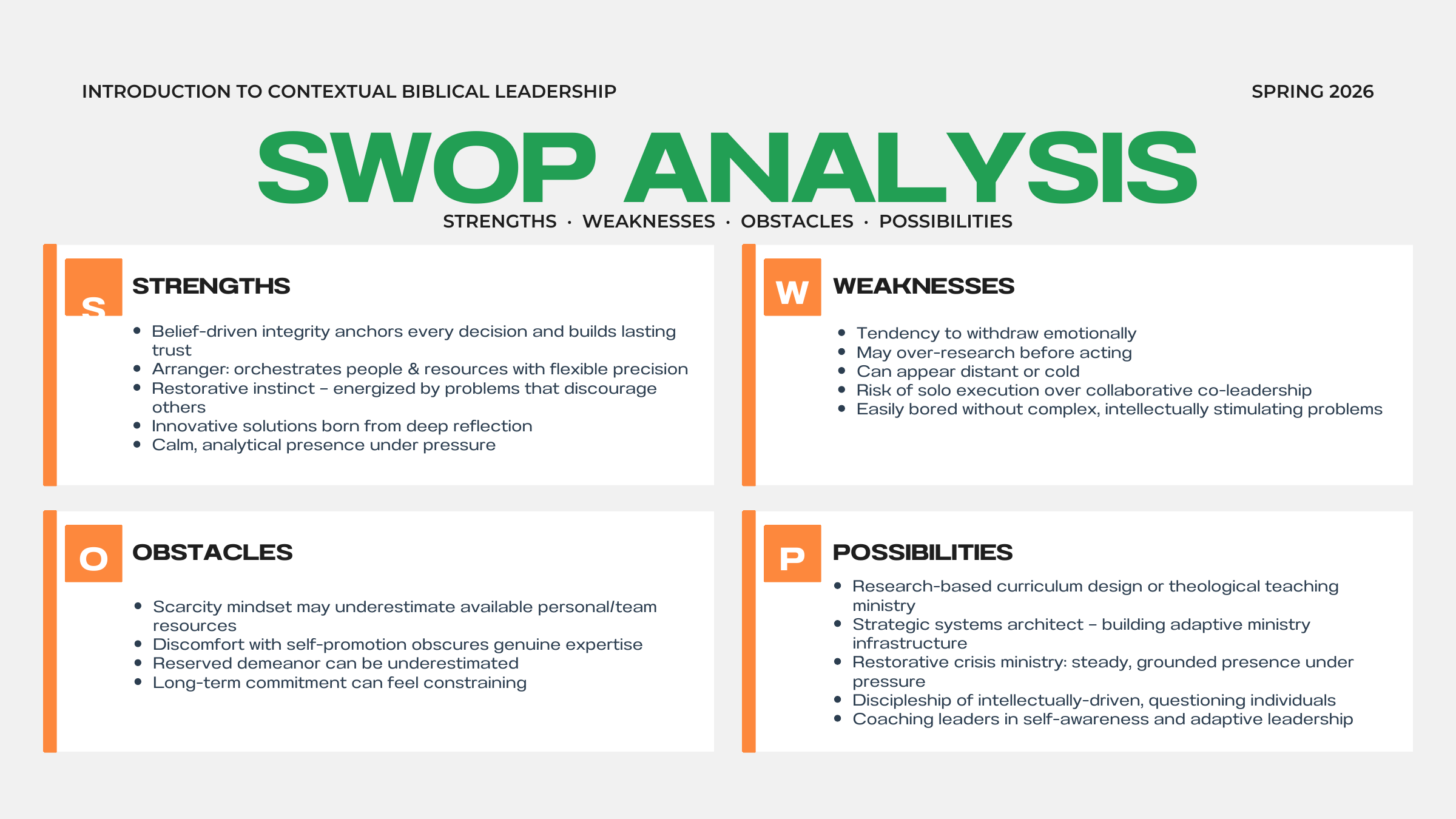
- The snapshot names strengths in systems, problem-solving, crisis steadiness, and strategic ministry infrastructure.
- The PDF images can be uploaded separately into Squarespace and placed below.
Bring in the Care
This paper diagnoses One City Church’s congregational care gap as an adaptive challenge rather than a technical problem.
- One City’s growth and mobile structure have made informal care pathways inconsistent.
- The deeper issue is shared ownership of the conviction that care belongs to the whole body.
- Stakeholders are protecting real values, yet the result is uncoordinated care.
Care as Calling
This paper grounds congregational care in Scripture, church history, and theology, arguing that the church is a visible, daily community of care.
- Paul’s body metaphor frames care as structural interdependence.
- Acts 6 shows the early church responding to rapid growth with care infrastructure.
- Early Christian care became a public witness.
The Shepherd-to-Shepherd Care Cascade
This paper proposes a leader-activated care model for pastoral staff, small group leaders, serve team leaders, and administrative volunteers.
- The model uses existing leadership relationships instead of creating an isolated care department.
- Leaders are asked to submit care needs immediately when they hear about them.
- Administrative volunteers convert intake into care cards within 24 hours.
Spiritual Autobiography
This autobiography tells the story of God’s formation through family, church, suffering, motherhood, surrender, and leadership.
Faith was formed in a praying family and a deeply charismatic Apostolic church context.
Personal suffering, spiritual sensitivity, and observation became part of the soil where ministry calling developed.
The story frames leadership as becoming the church: embodying the care, presence, and holiness God had modeled over a lifetime.
Leadership Snapshot
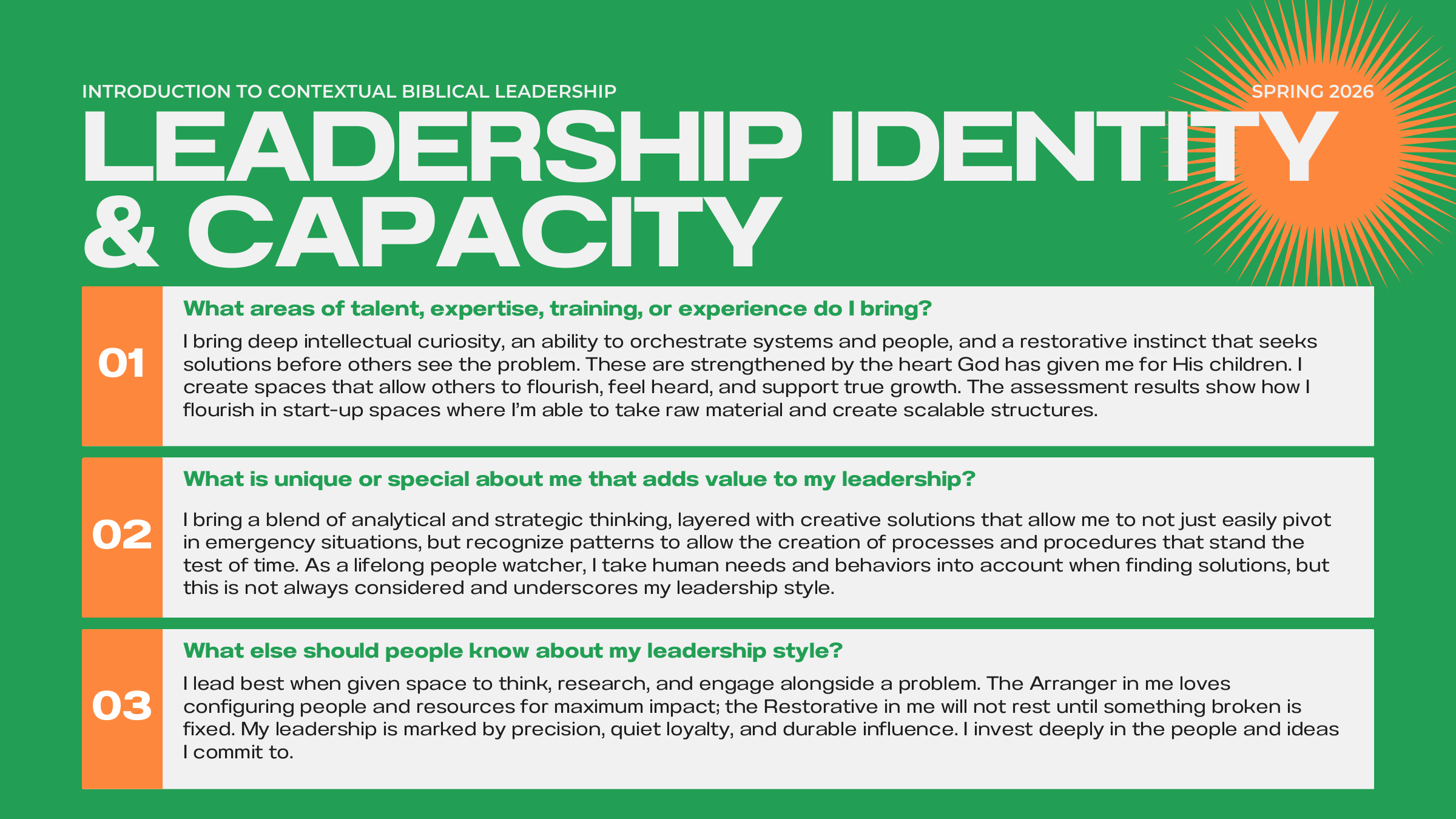
A visual leadership profile naming Asheley’s wiring, strengths, obstacles, possibilities, and leadership capacity.
Assessments identify a leadership style marked by analysis, clarity, independence, precision, and problem-solving.
The SWOP analysis names strengths in belief-driven integrity, systems orchestration, restoration, innovation, and calm under pressure.
The snapshot clarifies that Asheley leads best with room to think, research, organize complexity, and build durable ministry structures.
Problem Statement
This paper names the gap between One City’s value of care and the reality of inconsistent care coordination.
One City has care tools in place, including forms, QR codes, text options, and Church Center pathways.
The real challenge is adaptive: the congregation has not fully internalized shared ownership of care.
The paper identifies stakeholder values and losses so the intervention can address people, not just process.
Foundational
This paper argues that congregational care is not a side ministry, but part of the church’s identity as the body of Christ.
Scripture presents care as structural and communal through images like the body of Christ.
Jesus’ ministry and the early church establish care as visible, embodied, and extended beyond Sunday worship.
Historical evidence shows Christian care functioning as a public witness, even without permanent buildings.
Intervention and Implementation
This paper proposes the Shepherd-to-Shepherd Care Cascade as a scalable, leader-activated model for One City.
The intervention begins with pastoral staff endorsement so care becomes a visible pastoral priority.
Small group and serve team leaders are equipped to submit needs as soon as they hear them.
Administrative volunteers provide the Acts 6-style infrastructure that turns intake into timely care cards.
Resources
References are limited to resources already used in the existing assignment bibliographies.
- Dicken, Frank. Luke. 2023.
- García Martínez, Florentino. The Dead Sea Scrolls Translated. 1996.
- Hagner, Donald A. The New Testament: A Historical and Theological Introduction. 2012.
- Heifetz, Ronald, Alexander Grashow, and Marty Linsky. The Practice of Adaptive Leadership. 2009.
- Jipp, Joshua W. Saved by Faith and Hospitality. 2018.
- Justin Martyr. First Apology.
- Eusebius. Church History. 1999.
- Julian the Apostate. Epistles.
- The Holy Bible, English Standard Version.